
MS Chequered Plate Weight Calculator
Kg/m² & Kg/Sheet Charts · Diamond, Lentil & Round Bean · 2.5–12mm
MS chequered plate weight calculator created by renowned MS plate Manufacturer, Supplier & Stockist-Pm Industries.
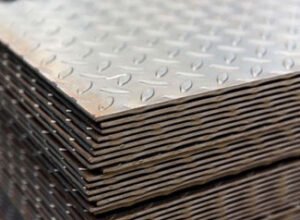
MS chequered plate – also called checker plate or chakkar plate in the trade – is mild steel plate with a raised diamond, lentil or round bean pattern rolled onto one face for anti-skid grip. This page covers 2.5mm to 12mm thickness: use the calculator below for an instant weight estimate in kg and kg/m², or jump straight to the kg/m² and kg/sheet charts further down.
MS Chequered Plate Weight Calculator
Select pattern & thickness, enter size and quantity, then calculate.
Note:- 10mm & 12mm use a theoretical flat-plate estimate (no published pattern-specific chart at this thickness) — see the disclaimer below.
How Accurate Is This Calculator? (Please Read)
This tool gives an estimate, not a certified or billing weight. Here is exactly how it works, so you can judge the number for yourself:
For 2.5mm to 8mm, the calculator looks up the published chequered-plate weight-per-square-metre figure for your chosen pattern (Diamond, Lentil or Round Bean) from the reference chart further down this page, then multiplies it by your entered area and quantity. These figures are the same ones widely used across the chequered-plate trade and should sit close to typical mill weight, within normal rolling tolerance.
For 10mm and 12mm, no verified pattern-specific chart is available, so the calculator switches to the plain theoretical formula: Area (m²) × Thickness (mm) × 7,850 kg/m³ (standard mild steel density) ÷ 1000. This does not add any extra weight for the raised chequer pattern, so real plate at these thicknesses will typically come out around 5–10% heavier than shown.
Beyond the chart and formula, actual weight can also move a little because of rolling thickness tolerance permitted under IS 2062 / IS 3502 (plate is rarely exactly nominal thickness), pattern height and formation differences between mills, cutting/shearing tolerance on width and length, and any coating such as paint or galvanising.
Use this calculator to budget, plan logistics and get a quick ballpark figure. For quotations, purchase orders or anything billed, please confirm the exact weight with PM Industries — we invoice on actual weighment at dispatch, never on a calculated figure.
How to Calculate weight of a Chequered Plate
To calculate the weight of a chequered plate, you can follow these steps:
-
Determine the dimensions of the plate:
- Measure the length (L) and width (W) of the chequered plate in millimeters (mm).
- Note the thickness (T) of the plate in millimeters as well.
-
Calculate the area of the plate (A) in square millimeters:
- ( A = L \times W )
-
Determine the density of the material of the chequered plate (usually specified in kg/mm³ or equivalent units).
-
Calculate the volume of the plate (V) in cubic millimeters:
- ( V = A \times T )
-
Convert the volume to cubic meters (m³):
- ( V_m = V \times 10^{-9} )
-
Calculate the weight of the plate (W) in kilograms:
- ( W = V_m \times Density )
By following these steps, you can accurately determine the weight of a chequered plate based on its dimensions and material density.
MS Chequered Plate Weight Per Sheet (8x4 ft / 2400 × 1200mm) – By Thickness, Diamond Pattern
| Thickness | Kg / Sq Metre | Kg / Sheet | Sheets / Tonne |
| 2.5mm | 21.6 | 62.21 | 16.08 |
| 3mm | 25.6 | 73.73 | 13.56 |
| 3.5mm | 29.5 | 84.96 | 11.77 |
| 4mm | 33.4 | 96.19 | 10.40 |
| 4.5mm | 38.6 | 111.17 | 9.00 |
| 5mm | 42.3 | 121.82 | 8.21 |
| 5.5mm | 46.2 | 133.06 | 7.52 |
| 6mm | 50.1 | 144.29 | 6.93 |
| 7mm | 59.0 | 169.92 | 5.89 |
| 8mm | 66.8 | 192.38 | 5.20 |
| 10mm* | 78.5 | 226.08 | 4.42 |
| 12mm* | 94.2 | 271.30 | 3.69 |
Diamond pattern (most common in India); Lentil and Round Bean weigh marginally less per sheet – see the kg/m² comparison chart below. *10mm & 12mm use the theoretical flat-plate formula (area × thickness × 7,850 kg/m³), since no published pattern-specific chart exists at these thicknesses – see the accuracy disclaimer below.
MS Chequered Plate Weight Per Square Metre (Kg/m²) – By Thickness & Pattern
|
Basic thickness
|
Allowable deviation
|
Weight(kg/m2) | ||
| Diamond | Lentil | Round bean | ||
| 2.5 | ±0.3 | 21.6 | 21.3 | 21.1 |
| 3 | ±0.3 | 25.6 | 24.4 | 24.3 |
| 3.5 | ±0.3 | 29.5 | 28.4 | 28.3 |
| 4 | ±0.4 | 33.4 | 32.4 | 32.3 |
| 4.5 | ±0.4 | 38.6 | 38.3 | 36.2 |
|
5
|
0.4 |
42.3
|
40.5
|
40.2
|
| -0.5 | ||||
|
5.5
|
0.4 |
46.2
|
44.3
|
44.1
|
| -0.5 | ||||
|
6
|
0.5 |
50.1
|
48.4
|
48.1
|
| -0.6 | ||||
|
7
|
0.6 |
59
|
58
|
52.4
|
| -0.7 | ||||
|
8
|
0.6 |
66.8
|
65.8
|
56.2
|
| -0.8 | ||||
This is the exact reference chart the calculator above uses for 2.5–8mm thicknesses. For 10mm and 12mm, no verified pattern-specific chart is published, so the calculator switches to the theoretical flat-plate formula explained in the disclaimer below.
How To Calculate weight of MS Chequered Plate
to Calculate the weight of an MS (Mild Steel) Chequered plate, you can follow these steps:
-
Calculate total area in Square Feet: This can be done by multiplying the length and the width of the plate.
Total Area = Length (ft) × Width (ft)
-
Calculate total area in Square Meter: To do this, convert the area from Square Feet to Square Meter using the conversion factor 0.092903.
Total Area (M^2) = Total Area (ft^2) × 0.092903
-
Calculate volume: Now to find the volume of the MS chequered plate, we multiply the total area in Square Meter by the thickness in mm divided by 1000 (since thickness is generally given in mm, and to convert it to meters, we divide by 1000).
Volume (M^3) = Total Area (M^2) × (Thickness (mm)/1000)
-
Calculate weight: Mild steel has a density of approximately 7850 kg/m^3. So to calculate the weight, multiply the volume by the density.
Weight (Kg) = Volume (M^3) × 7850 (kg/M^3)
Please note that the final weight may be subject to factors such as manufacturing processes and additional coating, etc. Always cross-verify with your supplier or manufacturer.
Let’s take an example for clarity:
Say we have a MS chequered plate that is 5ft x 3ft with a thickness of 8mm.
- Total Area in Square Feet = 5 ft x 3 ft = 15 ft^2
- Total Area in Square Meters = 15 ft^2 * 0.092903 = 1.393545 m^2
- Volume = 1.393545 m^2 * (8mm / 1000) = 0.01114836 m^3
- Weight = 0.01114836 m^3 * 7850 kg/m^3 = 87.514626 kg
So the weight of the MS chequered plate is approximately 87.51 Kg using the plain flat-plate formula. Note this simple formula excludes the raised chequer pattern — the calculator above gives a closer estimate for 2.5–8mm using the pattern-specific chart.
Chequered Plate Weight Chart – By Length, Width & Thickness
|
Product
|
Size | Weight | ||
| Length | Width | Thickness | Kg/Mtr | |
| Chequered Plate |
2500mm | 1250mm | 3mm | 75 kg |
| Chequered Plate |
5000mm | 1250mm | 3mm | 150 kg |
| Chequered Plate |
2500mm | 1250mm | 4mm | 100 kg |
| Chequered Plate |
5000mm | 1250mm | 4mm | 200 kg |
| Chequered Plate |
2500mm | 1250mm | 5mm | 125 kg |
| Chequered Plate |
5000mm | 1250mm | 5mm | 250 kg |
| Chequered Plate |
2500mm | 1250mm | 6mm | 150 kg |
| Chequered Plate |
5000mm | 1250mm | 6mm | 300 kg |
| Chequered Plate |
2500mm | 1250mm | 8 mm | 200 kg |
| Chequered Plate |
5000mm | 1250mm | 8mm | 400 kg |
| Chequered Plate |
2500mm | 1250mm | 10mm | 250 kg |
| Chequered Plate |
5000mm | 1250mm | 10mm | 500 kg |
| The data given above is indicative. Actual weights may vary. | ||||
These Kg/Mtr figures use the plain flat-plate formula (length × width × thickness × 7,850 kg/m³) and do not add the raised-pattern allowance – for a closer estimate on 2.5–8mm Diamond, Lentil or Round Bean pattern, use the calculator above or the pattern-specific chart further up this page.
Frequently Asked Questions
What density does this calculator use for MS chequered plate?
It uses 7,850 kg/m³ (7.85 g/cm³), the standard density for mild steel (IS 2062 grade) used across the Indian steel trade. Actual density varies marginally, roughly 7,750 to 7,870 kg/m³, with exact chemistry, so this is a close approximation rather than a lab-measured value for your specific batch.
How accurate is this MS chequered plate weight calculator?
For 2.5mm to 8mm thickness it uses a published industry weight-per-square-metre table for the diamond, lentil and round bean patterns, so results are close to typical mill weights. For 10mm and 12mm, no published pattern chart exists, so the calculator falls back to a plain flat-plate formula that excludes the raised pattern; real plate at these thicknesses usually weighs about 5 to 10 percent more. Treat every result as an estimate for budgeting and planning, not a certified or billing weight.
What is the difference between Diamond, Lentil and Round Bean chequer patterns?
These are the three common raised anti-skid patterns rolled onto one face of a chequered plate. Diamond has a rhombus-shaped raised pattern and is the most widely used in India; lentil (teardrop) has an oval raised bead; round bean has a rounder, lower-profile bead. Diamond pattern generally adds the most extra weight per square metre, followed by lentil, then round bean.
Will I be billed the exact weight shown by the calculator?
No. Invoices are based on the actual weighment of material at dispatch. Rolling tolerances permitted under IS 2062 and IS 3502, pattern height variation between mills, and cutting tolerance all cause small differences from any calculated figure.
Does this calculator work for stainless steel or aluminium chequered plate?
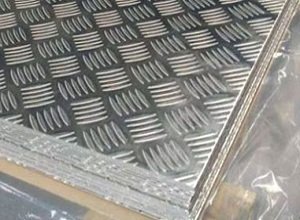
No, it is built specifically for mild steel at a density of 7,850 kg/m³. Stainless steel, around 8,000 kg/m³, and aluminium, around 2,700 kg/m³, chequered plate will weigh differently for the same size. Contact PM Industries for those grades.
Is chakkar plate the same as chequered plate?
Yes. Chakkar plate and checker plate are trade names used for the same product as chequered plate – mild steel plate with a raised diamond, lentil or round bean pattern rolled onto one face. The calculator and charts on this page apply equally whichever name you use.
What is the weight of chequered plate per square metre (kg/m²)?
It depends on thickness and pattern. For Diamond pattern – the most common in India – weight ranges from about 21.6 kg/m² at 2.5mm to 66.8 kg/m² at 8mm. See the Weight Per Square Metre chart above for the full breakdown by thickness and pattern, or use the calculator above, which shows kg/m² directly in the results.
What is chequered plate used for?
Chequered plate is mainly used for anti-skid flooring and walkways, staircases, ramps, platforms, truck and trailer flooring, ship decks and industrial catwalks. The raised pattern improves grip in wet or oily conditions compared to a plain flat plate.
Application
- Anti-Skid Flooring
- Staircases & Steps
- Ramps & Platforms
- Truck & Trailer Flooring
- Ship Decks & Gangways
- Industrial Catwalks
- Loading Bay Flooring
- Workshop Flooring
- Machinery Base Plates

Countries we Export:
Austria, Kuwait, France, Canada, Vietnam, Brazil, Ira, Thailand, Spain, Taiwan, Norway, Slovenia, Turkey, Maldives, Egypt, Argentina, Saudi Arabia, Bahamas, Slovakia Finland, Russia, Portugal, Puerto Rica, Malaysia, Malta, Germany, Oman, Bangladesh, Bahrain, Nigeria, UK, Hungary Albania, Bolivia, Netherlands, Mexico, Ukraine, Chile, Ecuador, Syria, South Korea, US, Sri Lanka, Paraguay, South Africa, Singapore, Sudan, Japan, Trinidad And Tobago, Qatar, Panama, Myanmar, Cyprus, Guyana, Belgium, Venezuela, Jordan, Switzerland, Costa Rica, the Republic Of Congo, Uruguay, Jamaica, Italy, Czech Republic, Yemen, Colombia, Iran, Cambodia, Equatorial Guinea, Libya, Greece, Angola, Denmark, Gabon, Indonesia, Ireland Croatia, Algeria.
Cities & State we Deliver:
Gujarat, Vasai-Virar, Hyderabad, Chandigarh, Jodhpur, Indore, Manipur, Agra, Telangana, Thane, Dhanbad, Maharashtra, Nagpur, Chhattisgarh, Kerala, Ghaziabad, Bihar, Delhi, Dadra and Nagar Haveli and Daman and Diu, Surat, Kalyan-Dombivli, Srinagar, Himachal Pradesh, Madurai, Assam, Faridabad, Uttarakhand, Jharkhand, Tripura, Salem, Visakhapatnam, Arunachal Pradesh, Jabalpur, Vadodara, Pune, Kota, Bhopal, Ranchi, Karnataka, Howrah, Meerut, Odisha, Rajasthan, Lucknow, Kolkata, Varanasi, Sikkim, Mizoram, Raipur, Haryana, Kanpur, Coimbatore, West Bengal, Madhya Pradesh, New Delhi, Aurangabad, Nagaland, Patna, Navi Mumbai, Puducherry, Andhra Pradesh, Gwalior, Amritsar, Goa, Chennai, Ahmedabad, Punjab, Meghalaya, Mumbai, Ladakh, Rajkot, Bangalore, Tamil Nadu, Vijayawada, Jammu and Kashmir, Allahabad, Uttar Pradesh, Jaipur, Ludhiana, Lakshadweep, Nashik.